How to Identify the Protagonist in a Story
This post contains affiliate links that earn commissions from qualifying purchases. In most stories, the protagonist is obvious: Harry Potter, Lisbeth Salander, and Katniss Everdeen are unquestionably the protagonists of their respective stories. But sometimes the protagonist isn’t so obvious. In some cases, a false protagonist is planted to intentionally mislead the audience, but the…Read More
36 Poetry Writing Tips
Poetry is the most artistic and liberating form of creative writing. You can write in the abstract or the concrete. Images can be vague or subtle, brilliant or dull. Write in form, using patterns, or write freely, letting your conscience (or subconscious) be your guide. You can do just about anything in a poem. That’s…Read More

Grammar Rules: Fewer vs. Less
It’s a battle between words: fewer vs. less. Are they interchangeable? Do these words have different meanings? How can we use them correctly? Many people don’t realize that these two words do not share the same meaning and therefore cannot be used interchangeably. As a result, both fewer and less are often used incorrectly. The…Read More

Why We Write, a Sneak Peek at Ready, Set, Write!
Today I’m sharing an excerpt from Ready, Set, Write! But first let me tell you about the book: Ready, Set, Write is an introduction to creative writing that is ideal for young and new writers but also works as a refresher for seasoned writers. It takes you on a tour through various forms of creative…Read More
How to Set Writing Goals to Stay Focused and Motivated
One of the things I love about writing is that it’s so accessible. All you need is a pen and a notebook (or access to a computer), and you’re off, putting your words down, expressing yourself. But it’s just as easy to lose your way — to let projects go unfinished, to procrastinate, or get…Read More
Writing Tips: Do It Anyway
From a distance, writing looks like one of the easiest jobs in the world. You get to set your own hours. You’re not tied to a place of employment. And you spend your days making up stories. However, writing is not as easy as it looks. It can be thrilling, exhilarating, daunting, and exhausting….Read More

Style Guides: Essential Writing Resources for Professionals
This post contains affiliate links that earn commissions from qualifying purchases. When we’re writing, we run into a lot of technical issues. Where do the quotation marks go? When is it correct to use a comma? How should titles be formatted? Some of these questions are answered by the rules of grammar, spelling, and punctuation….Read More
Poetry Prompts for Ranting and Raving
It’s easy to think of poetry as soft, flowery, and convoluted. It’s the stuff of Shakespeare, greeting cards, and children’s books. It’s precious, sweet, and erudite. But some of the most exciting modern poetry defies all those stereotypes, and you need look no further than the slam poetry and spoken word communities to see how…Read More

Writing Exercises: Writer, Know Thyself
Today’s writing exercise is an excerpt from 101 Creative Writing Exercises, a book packed with creative writing exercises and ideas. This exercise comes from chapter 2, “It’s Personal,” and it’s called “Writer, Know Thyself.” Enjoy! Writer, Know Thyself This exercise asks you to look in the mirror and ask yourself a critical question: Why do…Read More

Futuristic Inspiration for Speculative Fiction
How would people in the Middle Ages respond to a television? What would someone from the 1700s think of a helicopter? What would a person from the early twentieth century think of a computer, or more specifically, the internet? They would think these things were magical — either illusions or genuine supernatural occurrences. They might…Read More
Subscribe
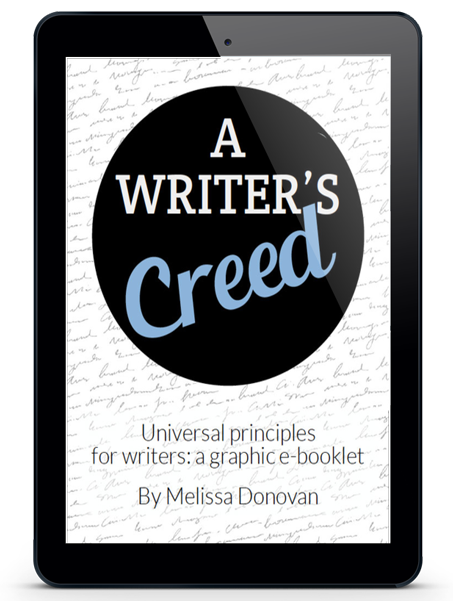
Subscribe and get The Writer’s Creed graphic e-booklet, plus a weekly digest with the latest articles on writing, as well as special offers and exclusive content.